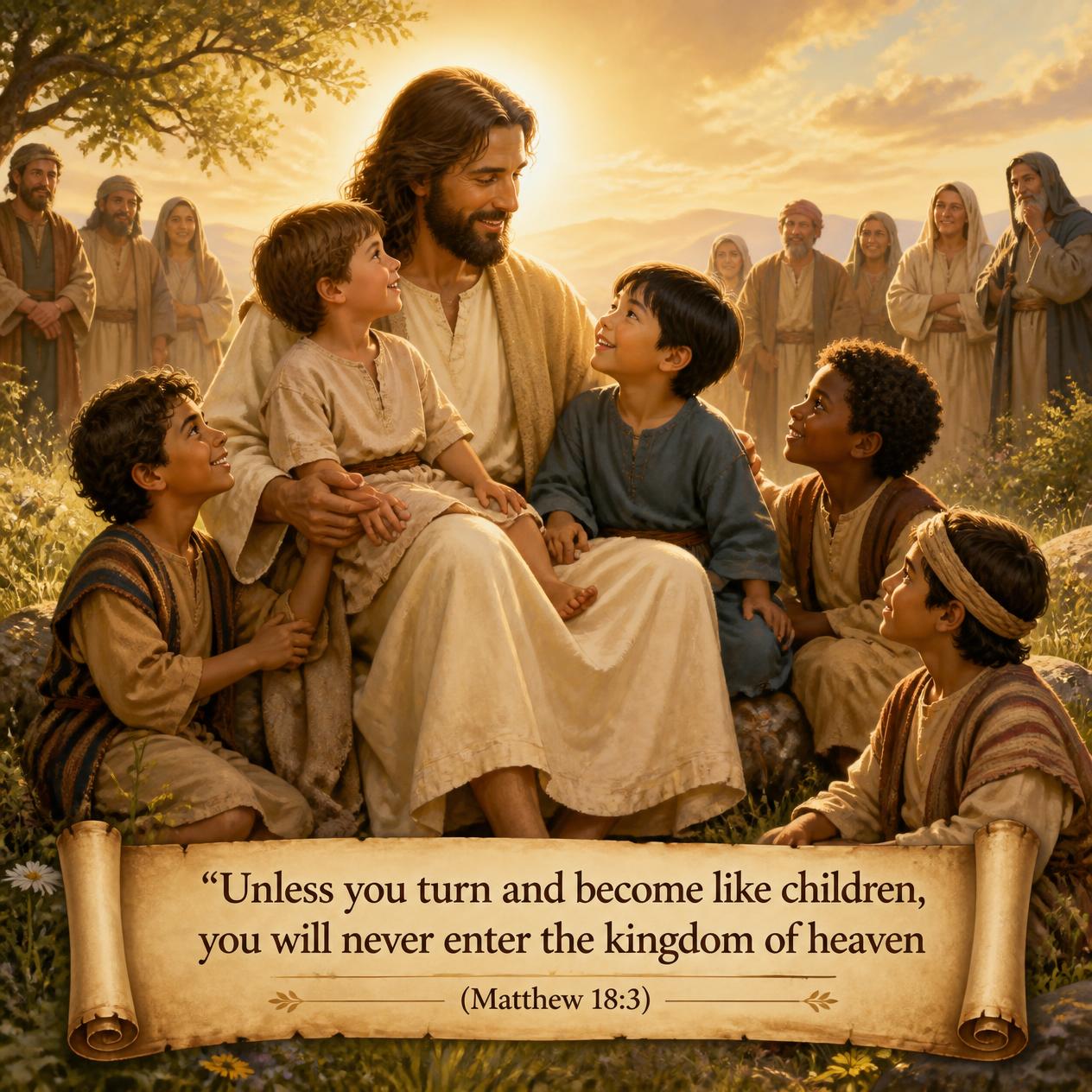
Have you ever watched a child trust their father completely? They jump into his arms without hesitation, believing with absolute certainty that he will catch them. They ask for what they need without shame. They forgive quickly and forget even faster. They believe what they are told without demanding a thousand proofs. This is the picture Jesus painted when He said, “Truly, I say to you, unless you turn and become like children, you will never enter the kingdom of heaven” (Matthew 18:3). These are startling words. Jesus is not saying that salvation is earned by being young or innocent. He is saying that the posture of the heart required to receive the kingdom is the posture of a child: humble, dependent, trusting, and teachable. Without this, no one can enter. Not the scholar. Not the wealthy. Not the powerful. Only those who come as little children.
What Is Childlike Faith?
Childlike faith is not childish faith. There is a world of difference. Childish faith is immature and self-centred and throws tantrums when it does not get its way. Childlike faith is humble, trusting, and secure in the love of the Father. Childlike faith does not mean checking your brain at the door. It means approaching God with a heart that is open, teachable, and willing to believe. It means saying, “God, I do not understand everything, but I trust You.” It means coming to Him not with arrogance or self-sufficiency, but with the simple confidence that He is good and He knows best. It is the faith that says with the psalmist, “O Lord, my heart is not lifted up; my eyes are not raised too high; I do not occupy myself with things too great and too marvelous for me. But I have calmed and quieted my soul, like a weaned child with its mother; like a weaned child is my soul within me” (Psalm 131:1-2).
Why Did Jesus Make This Statement?
Jesus made this statement in response to His disciples arguing about who would be the greatest in the kingdom of heaven (Matthew 18:1). They were jockeying for position, comparing themselves to one another, and seeking prominence. Jesus, knowing their hearts, called a little child to Himself and placed the child in their midst. Then He delivered this profound truth: greatness in the kingdom is not about status, power, or achievement. It is about humility. It is about recognizing that you are utterly dependent on God. The disciples wanted to know who was the greatest. Jesus showed them a child—someone with no power, no status, no achievements—and said, “Unless you become like this, you cannot even enter the kingdom.” The kingdom of God operates on a completely different value system than the world. The world says, “Climb higher. Be stronger. Prove yourself.” The kingdom says, “Come lower. Be weak. Trust Me.” The first shall be last, and the last shall be first (Matthew 20:16). The way up is down. The way to greatness is to become like a little child.

How Do We Recognise Childlike Faith?
Childlike faith is recognizable by several marks. First, it is marked by humble dependence. A child knows they cannot survive without their parents. They do not pretend to be self-sufficient. In the same way, those with childlike faith know they cannot live the Christian life in their own strength. They depend on God for everything—for provision, for guidance, for protection, for forgiveness.
Second, it is marked by simple trust. A child believes what their father tells them. They do not demand explanations for everything. They trust that their father has their best interests at heart. Those with childlike faith trust God’s Word even when they do not understand His ways. They believe His promises even when circumstances seem to contradict them.
Third, it is marked by quick repentance. A child who disobeys and is convicted quickly runs back to their father with tears, saying, “I’m sorry.” They do not rationalize, justify, or make excuses. They simply repent and receive forgiveness.
Fourth, it is marked by joyful simplicity. A child can find joy in the smallest things. They do not need extravagant entertainment to be happy. Those with childlike faith find joy in simple fellowship with God in a quiet moment of prayer, in a verse that speaks to their heart, in a song of worship.
How Do We Possess Childlike Faith?
Childlike faith is not something we manufacture; it is something we receive. It begins with humility.
We must acknowledge that we do not have all the answers. We must confess that we cannot save ourselves, sanctify ourselves, or sustain ourselves. We must come to God with empty hands, saying, “I need You.” Jesus said, “Blessed are the poor in spirit, for theirs is the kingdom of heaven” (Matthew 5:3). To be poor in spirit is to recognise your spiritual bankruptcy. It is to know that you have nothing to offer God except your need. This is the starting point of childlike faith.
Next, we must spend time with the Father. A child trusts their father because they know him. They have spent countless hours in his presence. They have experienced his love, his provision, and his protection. In the same way, we grow in trust as we spend time with God in prayer, in His Word, and in worship. The more we know Him, the more we trust Him.
Finally, we must practice trusting Him in small things. Faith is a muscle. It grows with use. Start by trusting God with your daily needs. Trust Him with your anxieties. Trust Him with your decisions. As you see His faithfulness in small things, your faith will grow for the bigger things.

How Do We Not Lose Childlike Faith?
The greatest danger to childlike faith is pride. Pride whispers, “You don’t need God. You can figure this out on your own. You’ve matured beyond simple faith.” Pride makes us self-reliant, self-sufficient, and self-centered. It closes our hearts to God’s voice and makes us resistant to His correction.
The antidote to pride is a continuous posture of humility. We must constantly remind ourselves that everything we have- our salvation, our gifts, our very breath is a gift from God. We must not become too sophisticated, too intellectual, or too experienced to simply believe. We must never outgrow our dependence on Him.
Another danger is unresolved pain. When we experience disappointment, loss, or betrayal, we are tempted to put up walls around our hearts. We become guarded, cynical, and suspicious. We stop trusting because we have been hurt. But childlike faith requires vulnerability. It requires opening our hearts to God, even when life has wounded us. We must bring our pain to Him and allow Him to heal us, rather than allowing it to harden us.
The Blessing of Childlike Faith
Why does Jesus say we cannot enter the kingdom without childlike faith? Because the kingdom is not earned; it is received. It is not achieved; it is given. Only those who come with empty hands can receive it.
Only those who acknowledge their need can be filled. Only those who trust like a child can enter the Father’s embrace. Childlike faith is not a weakness; it is a strength. It is the strength of knowing that you do not have to carry the world on your shoulders because you have a Father who holds the world in His hands.
It is the peace of knowing that you are loved, cared for, and secure. It is the joy of knowing that you do not have to have all the answers because you know the One who does. “But to all who did receive him, who believed in his name, he gave the right to become children of God” (John 1:12). You are a child of God. Come to Him like a child. Trust Him like a child. Love Him like a child. And never, ever lose that childlike faith.